

Acupuncture for Forward Head Posture & Neck Pain in Crystal Palace
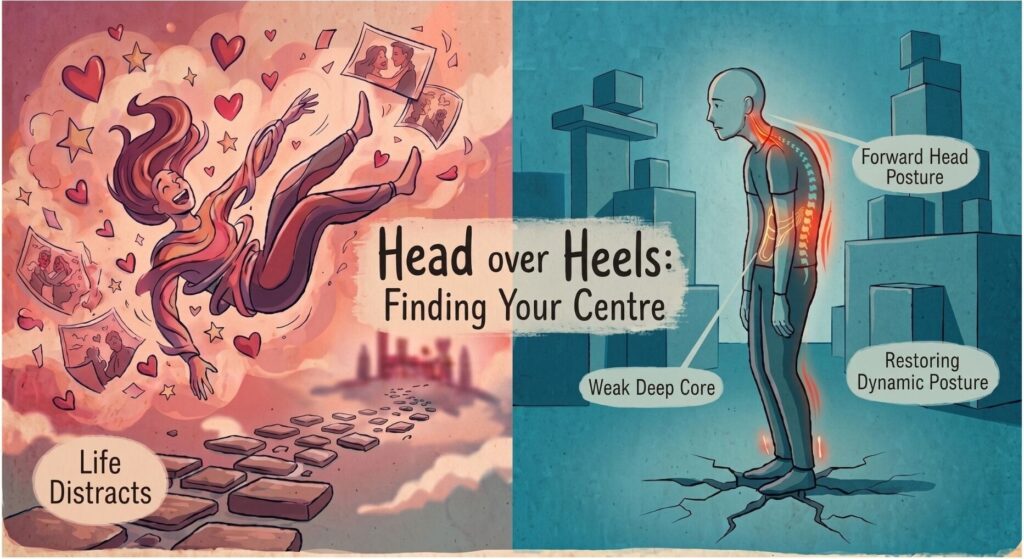
Love is a really potent emotion; it makes us feel discombobulated. Hence the term Head over Heels. However, I am not really here to talk about the wonders of human connection, but rather about the magical adaptability of the human body.
Especially how that translates to our ability to remedy forward head posture with acupuncture and postural adjustments.
When we fall in love, we sort of lose ourselves. We find ourselves distracted, yet fixated on one thing. The very same happens to us when we have not been taught to carry ourselves correctly (healthily) in the world.
In love, we lose our footing to the overwhelm of positive emotion. In everyday life, we lose our core/centre to the overwhelm of comfort (lounging) and discomfort (maladaptive muscle tension).
The result is the same: head over heels. But the reason is fairly different.
It would be rather impossible (and extremely smug) to say that it all starts in the same place; however, the deep core muscles are the number one culprits for forward head posture. Which, sadly, over time, results in a rounded upper back.
We might be thinking: “Why is my body doing this to me?”
And the answer is: because it is trying to stabilise you.
The body is a wonderfully adaptive machine. It does its absolute best to stay alive and as functional as possible. Disease is simply a manifestation of the body’s response and effort to stay alive.
Now, the good news is that most of us have a choice to avoid looking like Quasimodo.
Luckily for both of us, I have been fascinated by posture and integrated movement for a few years now. I have developed (and am still improving upon) a way to restore correct posture thanks to my many and truly amazing teachers who have been obsessed with healthy movement for decades.
How We Fix Forward Head Posture (Tech Neck)
To correct your head-over-heels problems, we need to primarily address:
- A weak and underactive deep core (primarily transverse abdominis and obliques).
- Shift the centre of your gravity slightly forward (to the balls of the feet).
- Allow the head to adjust its shape to the new posture.
Now that is a very simple list; however, each step has a multitude of foundational steps and conditions which need to be corrected, tested and trained into your everyday life in order to facilitate a change in your posture.
Why Your Core is the Root Cause of Postural Pain
Before I say more on that, here is a little blurb on the core.
There are different explanations around why it is so important, but one thing that all movement specialists agree on is that healthy movement starts from the centre. And when the structures around that (core, hips, diaphragm, rib cage, pelvic floor, etc.) are misaligned, it results in a cascade of issues everywhere in our musculoskeletal system.
That does not even cover the surface of what this means for our psychological health. Having a strong, active and adaptive centre (core) clearly translates back and forth to how robust our mental health and confidence are day-to-day.
When we lose stability in our centre, our body (and mind) adapts in myriad ways in order to restore it; hence, the head creeps forward in order to keep us balanced.
Our Approach: Acupuncture & Integrative Postural Correction
Here are a few examples of the work that integrative postural correction requires:
- It is fairly simple to activate the deep core, and it can be taught in about an hour. It is more challenging to build a habitual posture in which we can maintain this muscle activation whilst standing and without introducing unnecessary tension into the body.
- We must allow all the anatomy to adjust above and below to the core’s engagement, so the ribcage can maintain a healthy shape and so the legs and glutes can maintain correct alignment for your centre of gravity.
- Everyone’s adaptation is similar, yet different. Thus, it takes in-person assessment, adjustment and biofeedback to build a new habit (which is what we call posture).
- Actually, there is no correct posture. It is fully dynamic and will change in whatever scenario we put our body in. Thus, we need to build habits and cues which work for us, especially at times when our posture feels most challenging.
- It is not a quick fix. It requires work from you and a bit of slowing down. So we can best understand your patterns of adaptation.
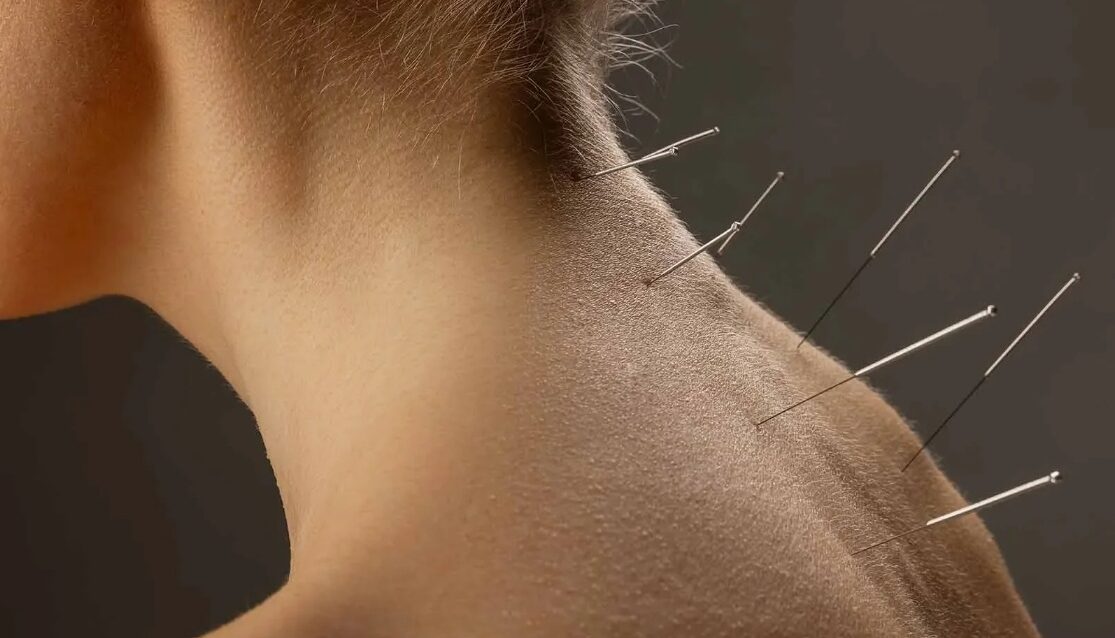
- Massage and acupuncture are a great help in loosening the chronically tense muscles. Melting those trigger points and relaxing the nervous system helps to alleviate that stubborn neck pain. But it is not enough to fight the symptoms without addressing the root causes behind it all.
Forward head posture is just an example of a maladapted posture. And it may or may not come with pain. However, it will greatly contribute to degenerative disorders later down the line.
All postural misalignments can be adjusted, such as scoliosis, but the outcomes are greatly dependent on how well you can work together with your therapist.
Why is it so hard to make lasting changes?
Because by default, people seek a way out of their suffering. A definitive answer to their question. When we fail to build joy and appreciation for the journey, it can feel very demoralising and repulsive to keep putting in effort for a slow return.
A great example is about shifting your centre of gravity (COG):
- First of all, we must play around with mindful movement until we start having an actual awareness of our COG. It is not as simple as rocking the body one way or another.
- The placement of all skeletal structures (big bones) will affect how the COG is playing out.
- For a skilful eye, most people look like disjointed pieces of Lego, held together by hundreds of elastic bands, all pulling in different directions.
- It takes a while to build both awareness and the skill to untangle these elastic bands, so the skeletal structure goes back to being freely suspended, instead of internally crushed by these bands.
- Thus we need not micromanage all those unnecessary pulling forces upon our COG. We can simply find new ways, which feel much more free and natural, to make our default.
- Yet, as soon as we introduce external stimuli (reaching for a dish, or feeling stressed), the body will go back to its maladapted state, until the nervous system feels safe enough to interact with the world in its new configuration.
- There is no magic to it. It simply takes practice. Repetition and awareness.
Book Your Posture Assessment in Crystal Palace & West Norwood
If you or anyone around you suffers from poor posture, forward head posture, chronic back pain, shoulder pain, or hip pain, or other nerve-related problems or hypermobility, then please reach out.
I would be more than happy to help you find your centre again at my clinic in South London. Available in West Norwood and Crystal Palace. Wednesday to Sunday.